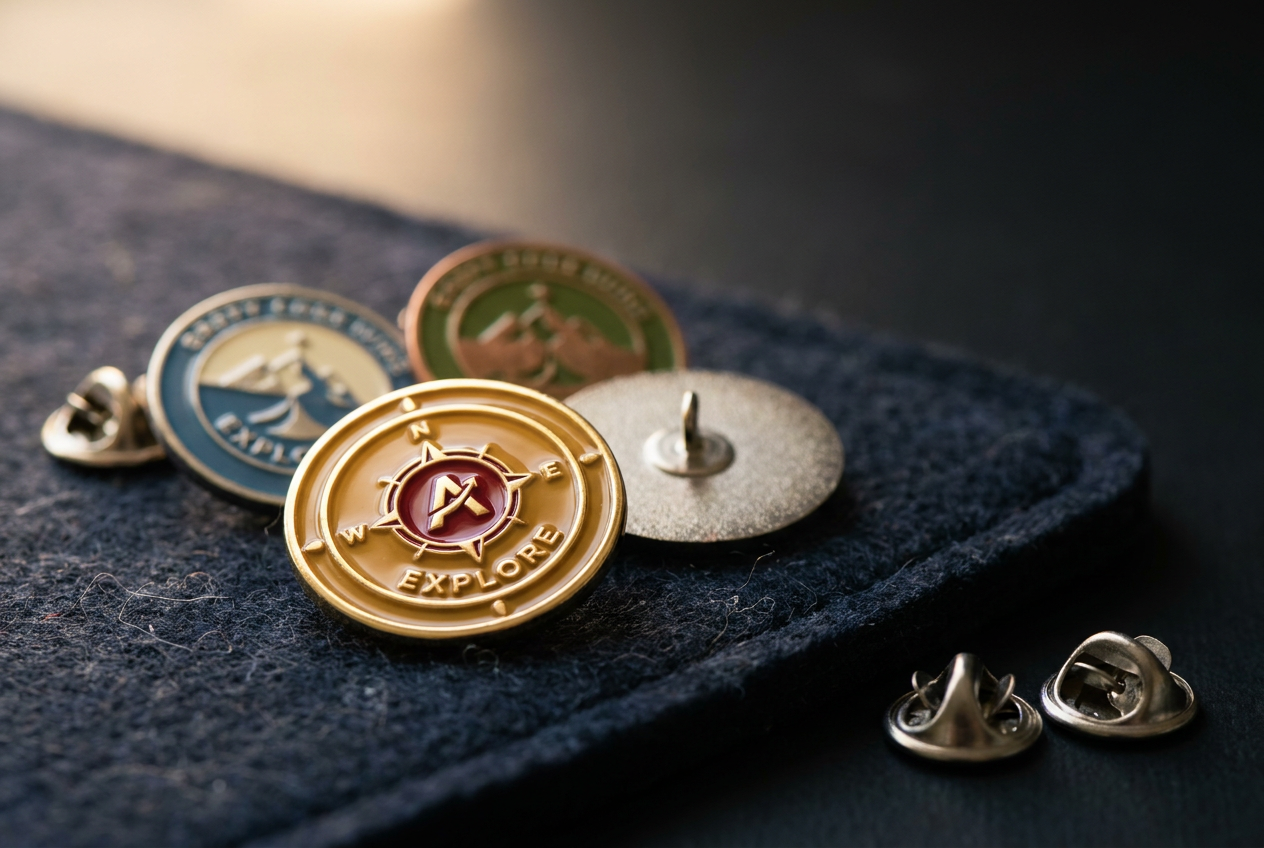
Answer: The six main types of lapel pins are soft enamel, hard enamel, die struck, printed photo, acrylic and photo-etched. Choose enamel for defined colors, die struck for metal detail and printing for photographs or gradients. Trading features, magnetic backings and name pins describe uses and attachments. They are not separate manufacturing processes.
Your logo looks sharp on a screen. Choose the wrong pin process and it comes back with the wrong texture, muddy color or lettering nobody can read. Start with the artwork and how people will wear the pin, then pick the method.
The NFHS counted a record 8,266,244 high school sports participants in 2024-25. That is a lot of seasons, volunteers and staff to recognize. Colucci Custom Awards makes custom pins in the USA at its Columbia, South Carolina facility, with a minimum order quantity of 1 piece.
| Pin type | How it is made | Look and feel | Best for | CCA product line |
|---|---|---|---|---|
| Soft enamel | A custom metal die stamps the design; enamel fills the recessed wells between raised metal outlines | Textured surface with distinct metal borders | Team artwork, event giveaways and bold logos | Soft enamel pins |
| Hard enamel | Enamel is overfilled, baked and ground flush | Smooth, glossy surface | Service awards and pins worn daily | Hard enamel pins |
| Die struck | A die presses the design into solid metal | Raised and recessed metal relief, no color | Insignia, commemorative emblems and formal awards | Die struck pins |
| Printed photo with epoxy dome | CMYK offset printing on metal, sealed under an epoxy dome | Glossy surface with photographic detail | Portraits, memorials and full-color artwork | Photo pins |
| Acrylic | Full-color print on clear acrylic, laser-cut to shape | Lightweight with edge-to-edge imagery | Gradients and detailed illustrations | Acrylic pins |
| Xpress photo-etched | Artwork is etched into metal and color filled, no die to cut | Metal detail with defined color areas | Logos that read clearly at 1 inch | Xpress pins |
| Trading pins | A custom pin with options such as spinners, sliders, danglers and glitter | Collectible features with movement or sparkle | Tournament exchanges and team collections | Trading pins |
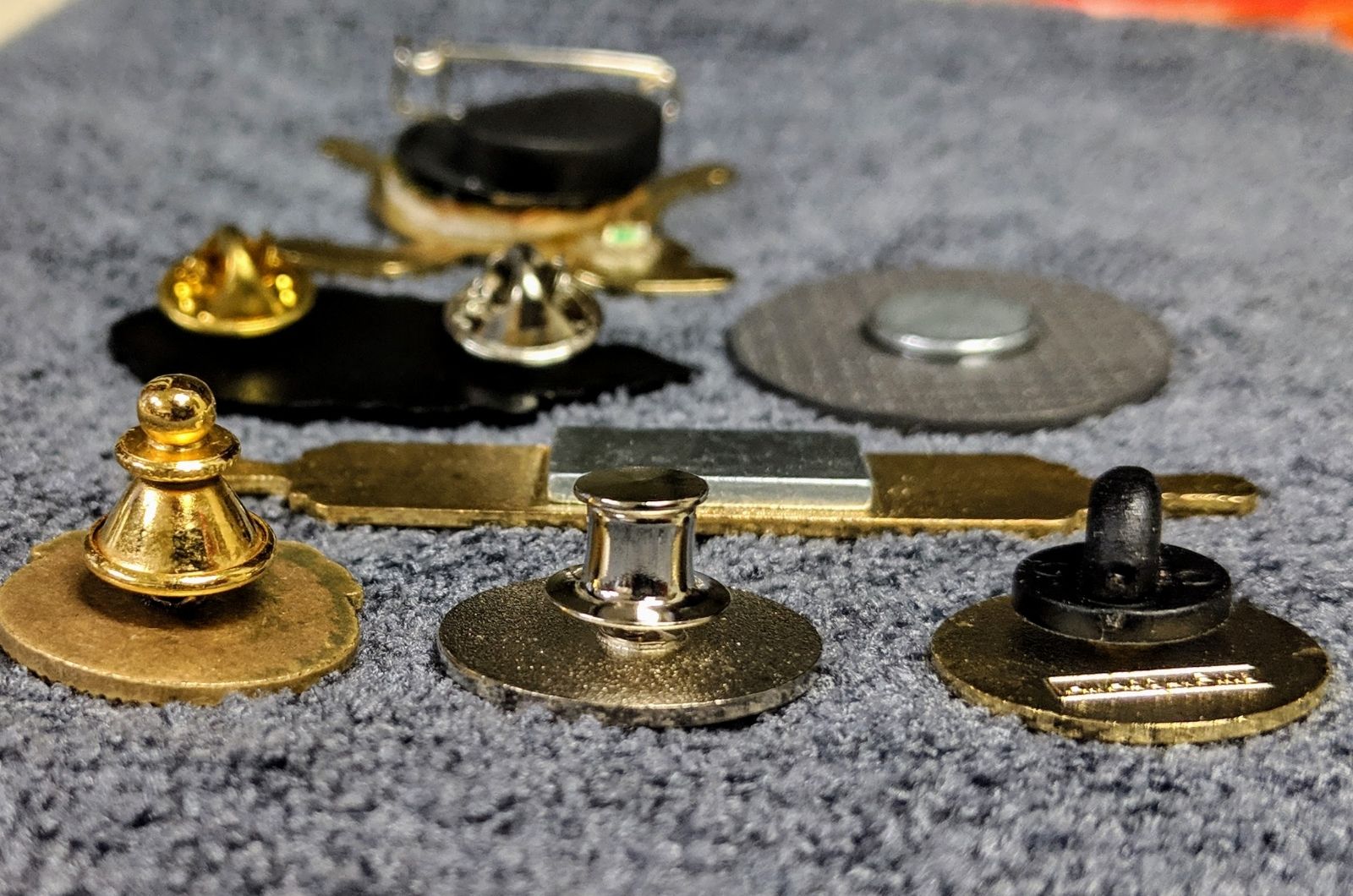
| Magnetic backing | Magnets hold the pin through clothing without a piercing post | The front finish depends on the pin style chosen | Blazers, scrubs and garments you don’t want punctured | Magnetic pins |
| Name pins | Names appear in engraved metal or full color under an epoxy dome | Readable identification for repeated wear | Staff uniforms and professional attire | Name pins |
Enamel Pins: Smooth or Textured Color
Hard enamel pins
Hard enamel is overfilled, baked and ground flush with the metal. The face comes out smooth and glossy. Run a fingertip across it and you feel no ridges.
Choose hard enamel for service awards, membership emblems and pins people wear every day. Keep lettering readable and color areas distinct, especially when you shrink a large organizational logo to pin size.
Soft enamel pins
Soft enamel sits below the raised metal outlines. A custom metal die stamps the design into the metal, and enamel fills the recessed wells. You see and feel every border.
This style works for bold school emblems, volunteer awards, event giveaways and team artwork with clearly separated colors. Pick soft enamel when you want visible relief, because not every colored metal pin has the same finish.
Die Struck Pins: Let Metal Define the Design
Die struck pins press your design into solid metal with a die. The result is raised and recessed relief, much like a minted coin. There is no enamel color, so relief and finish carry the whole design.
CCA lists polished gold, silver and antique bronze finishes. Polished finishes stay bright and reflective. Antique finishes darken the recessed areas for contrast.
A strong silhouette, a clear emblem and minimal lettering suit this approach. If your organization depends on specific brand colors, compare an enamel version before you approve an all-metal pin.
Printed Photo Pins and Acrylic Pins
Photo pins with an epoxy dome
Photo pins use CMYK offset printing directly onto a metal base. A thick, protective epoxy dome seals the print and gives the face a glossy finish.
Use this process for portraits, memorial pins, keepsakes and artwork with blended colors. Printing reproduces tonal shifts that enamel would split into separate color areas.
On award pins with photos, make the person or subject large enough to recognize. A busy background fights the image and leaves less room for names or award wording.
Acrylic pins
Acrylic pins are printed in full color on clear acrylic, then laser-cut to shape. CCA lists edge-to-edge printing, gradients and intricate illustrations as strengths of this lightweight option.
Choose acrylic when the printed image and the outline matter more than a metal surface. Check narrow points and small decorative details on the proof before you approve it.
Xpress Photo-Etched Pins Are a Separate Process
Photo-etched does not mean photographically printed. On Xpress pins, your artwork is etched into the metal and color filled, with no die to cut.
Xpress comes in one size: 1 inch. Backing choices are butterfly clutch and rubber clutch, with magnetic on request. Confirm your logo and lettering read clearly at 1 inch before you commit.
Compare Xpress with enamel when your artwork uses defined color areas. For a portrait or a continuous gradient, choose a printed photo pin. The word “photo” in the name does not mean photographic reproduction.
Trading Features, Magnetic Backings and Name Pins
Trading pins add collectible features
“Trading” describes how people swap and collect pins, not one manufacturing method. CCA lists spinners, sliders, danglers, glitter and blinking lights among its trading pin options, each quoted per feature.
Start with a recognizable team emblem, then add one accent that supports it. A spinner adds movement. A dangler adds a hanging element. Glitter changes the look of selected color areas.
Magnetic backings change the attachment
A magnetic backing holds the pin through clothing without piercing the fabric. It changes the attachment only. Enamel, printing or metalwork still decides the front.
CCA lists magnetic backings as compatible with nearly all of its pin styles, including hard enamel, soft enamel, die struck and photo pins. Match the backing to the garment your recipients actually wear.
A large pin on a single post can rotate or pull at thin fabric. For lightweight uniforms, ask whether a second post or a magnetic backing suits the garment before you approve the order.
Name pins prioritize identification
Name pins put the wearer’s name at the center of the layout. CCA offers them in engraved metal and full color for scrubs, uniforms and professional attire, with magnetic backs available.
Give the name room before you add a department, title or logo. A recognition emblem and a daily ID pin do different jobs, even when they share a design.
Where Small Artwork Creates Ordering Problems
Too much information competes for limited space
A logo built for a presentation slide carries more detail than a lapel pin can hold. Small lettering, thin outlines and background decoration compete with the main emblem once the artwork shrinks.
Review the proof at the finished size, not as an enlarged screen image. Check the organization name, date and central symbol first. If those are hard to read, simplify the artwork before you add decorative features.
For a school award, lead with the achievement and the school. For a name pin, lead with the wearer. That hierarchy gives the manufacturer a clear brief and keeps revisions focused.
A color reference does not guarantee the same effect
Solid brand colors, photographic shading and metallic finishes are three different goals. Treat them as interchangeable and the conversion disappoints, especially when a shaded logo gets split into separate enamel compartments.
Decide what must not change before you pick a process: a portrait, a specific color relationship or the shape of an institutional seal. Then decide whether texture, smoothness or photographic detail matters most.
Ask for a proof that shows how the chosen process handles those priorities. Compare lettering, borders and color areas together. A finish that suits one emblem does not automatically suit every design in your organization.
An event date requires more than a shipping choice
Put your required arrival date in the first request, alongside quantity, artwork, finish and backing. Production and shipping are separate parts of the order, so cover both before you approve the design.
CCA publishes prices on its pin pages, and custom orders vary with the customization and design. Use the pin cost estimator to price your order, then confirm the full specification and any one-time setup charge. Xpress pins have no die to cut, so compare them when a die-based style would add setup cost to a small order.
Turnaround also depends on the customization and design. Ask whether overnight shipping is available for your order, and keep the ceremony date in front of everyone through approval.
How Pin Finishes Compare With Challenge Coins
Challenge coins follow the same enamel split. Soft enamel leaves recessed color. Hard enamel produces a flush surface. Die struck designs rely on metal relief instead of color.
The presentation is what changes. A pin attaches to clothing for visible identification or recognition. A coin goes into the recipient’s hand and stays with them as a keepsake.
Coordinating pins and coins for one program? Read the soft enamel vs hard enamel challenge coin guide on the CCA blog. Review each layout on its own, since lettering and detail take up different amounts of space on a pin and a coin.
Which Lapel Pin Type Fits Your Artwork?
Look at your artwork and name the one thing that has to hold up at pin size. If it is a set of brand colors, ask for an enamel proof: soft for texture, hard for a flush face. If it is a seal or emblem, ask for die struck. If it is a face or a gradient, ask for a printed photo or acrylic proof. If it is a small logo, test it at 1 inch as an Xpress pin.
Send your artwork, quantity, backing preference and required arrival date to request a free quote. Colucci Custom Awards owns the manufacturing, so you get factory-direct pricing with no middle-man markup.
Frequently Asked Questions (FAQs)
What are the different types of lapel pins?
There are six main types of lapel pins: soft enamel, hard enamel, die struck, printed photo, acrylic and photo-etched. Trading pins and name pins describe uses. Magnetic describes an attachment option, not a manufacturing process.
What is the difference between soft enamel and hard enamel pins?
Soft enamel sits below raised metal outlines, so you see and feel the texture; it suits team artwork and event giveaways. Hard enamel is ground flush with the metal for a smooth surface; it suits service awards and pins worn daily. CCA has a product page for each style.
Which pin type is best for photos or full color?
Printed photo pins are best for photographs and blended tones. CCA prints them in CMYK directly onto metal and seals them under an epoxy dome. Acrylic pins are the other full-color option, for detailed illustrations and gradients.
How much do custom lapel pins cost?
Prices are published on each CCA pin page, and custom orders vary with the customization and design. Style, quantity, artwork, backing and any one-time setup charge all affect the total. Run your numbers in the pin cost estimator before you request a quote.
Who makes custom lapel pins in the USA?
Colucci Custom Awards makes custom lapel pins in Columbia, South Carolina, where the Colucci family has crafted awards since 1940. The range covers enamel, die struck, photo, acrylic and photo-etched pins, with a 1-piece minimum. Browse the full custom pins range on the CCA site.