Identification hardware either holds up or it does not. Military units, law enforcement divisions, and athletic programs regularly receive tags that corrode inside a season, wear smooth against uniform fabric, or land after the ceremony has passed. Misprinted service numbers and snapped chains cost you the order twice.
This is a crowded supply market. U.S. distributor sales of branded and promotional goods reached $27.1 billion in 2025, up 1.3%, according to PPAI Research. Volume that large pulls in plenty of sellers who never touch a stamping press.
Getting the hardware right pays off for years. ASI’s Global Advertising Impressions Study reports that 85% of consumers remember the advertiser who handed them a logoed product. A unit crest stamped into steel and worn every day carries that recall further than anything printed.
A dedicated military dog tag maker fixes the failure points at the source: a named alloy, mil-spec blank dimensions, deep mechanical debossing, and human inspection before anything ships.
Where Custom Dog Tag Orders Go Wrong
Personalized military dog tag orders fail for the same seven core reasons. They stack up in sequence, and every one of them is cheaper to prevent than to reprint.
- Unspecified base metal. Budget shops swap military-grade stainless for soft aluminum or zinc that bends on impact and pits after a few weeks of sweat exposure.
- Shallow marking. Surface printing and light laser scoring rub off against uniform fabric, and the contact details go unreadable within months.
- No mil-spec dimensions on the order. Issue tags carry a defined blank size, corner radius, and rolled edge. A shop working from a generic flat blank ships something that reads close but sits wrong under a uniform and will not seat properly in a standard silencer.
- Chain hardware chosen on price alone. Ball chain has to carry the tag through years of wear and still give way under load rather than cinch down on the wearer. A chain ordered without a stated gauge and clasp type is the component that fails first, and it takes the tag with it.
- Inconsistent plating. High-volume runs without manual inspection produce color variance, loose silencer fit, and mismatched metal tone inside a single order.
- Overseas delivery risk. Customs holds and shipping delays leave you with no recourse when the banquet or promotion ceremony arrives first.
- No proof before payment. Approving a flat sketch instead of a rendered proof is how misspelled names and crooked crests reach production.
Material Specifications That Decide Tag Life
Tags live on chains under body armor, in salt air, and through years of laundry cycles. The alloy decides how that story ends.
Stainless Steel vs. Brass
Custom stainless steel dog tags start with a stated grade, not a stated color. Grade 304 stainless is the default for standard-issue tags. It resists rust, holds a stamped edge cleanly, and takes either a matte or polished finish.
Grade 316L adds molybdenum, which buys real resistance to saltwater and chemical exposure. Naval, coastal, and marine units should specify 316L by name on the purchase order. Brass reads warmer and suits commemorative unit tags and legacy award sets, though it needs a clear protective coat or it will oxidize.
Silencers and Chain Hardware
Silicone silencers kill the metal-on-metal noise and shield the tag edge from chipping. Ask for medical-grade silicone. The cheap compounds yellow and split.
Stainless ball chain is the standard attachment. Confirm chain gauge, length, and clasp type in writing before production, because that one line item drives most reorders. A shorter chain turns the same blank into a custom dog tag necklace for off-duty or commemorative wear.
Debossing, Stamping, and Die-Striking
How the text gets into the metal matters more than the finish sitting on top of it.
Deep Mechanical Debossing
Traditional tags are debossed. Calibrated dies press each character down into the steel, and the relief survives even after surface paint or plating wears away. That is the entire point of a tag someone may need to read decades from now.
Laser engraved military dog tags look sharp on day one. The mark sits shallow in the surface, so it lightens exactly where the tag rubs against fabric and gear. Ask any maker what press and die set they run. A shop that owns the equipment answers in one sentence. A reseller changes the subject.
Die-Struck Crests and Logos
Unit insignia, department seals, and athletic crests call for die-striking. Steel dies compress the blank under hydraulic pressure and lock fine detail into the surface, the same process behind a custom challenge coin. Fine linework holds at small scale in ways etching does not.
Comparing Your Sourcing Options
Four routes exist for a custom tag order. They differ most in what you get to specify, and in what happens when the date slips.
| Sourcing Route | Metal Grade Control | Minimum Order | Proof Before Payment | Turnaround |
|---|---|---|---|---|
| Colucci Custom Awards (USA factory-direct) | Grade specified per order, stainless or brass | None. One tag or 500 | Free 3D digital proof, revised until you sign off | 3 to 6 weeks |
| Overseas bulk manufacturer | Varies by vendor, grade often unstated | Commonly set in the hundreds | Flat artwork proof where offered | Not publicly listed, plus customs |
| Online print-on-demand tag shop | Fixed catalog stock only | 1 | Auto-generated screen preview | Varies by seller |
| Local trophy shop reseller | Depends on the factory behind them | Set by their supplier | Paper or screen mockup | Adds a handoff to the factory schedule |
Unstated cells reflect information the supplier does not publish. Treat a missing metal grade as a red flag, not an oversight.
Deadline Math
Work backward from the ceremony, not forward from the order date. Add proof approval, production, and shipping, then add a week you do not plan to use.
A 3 to 6 week domestic window gives you that cushion. An overseas quote that reads “4 to 5 weeks” counts factory time, and customs clearance sits outside it. Customs is exactly where the ceremony gets missed.
Pairing Dog Tags With the Rest of Your Recognition Program
Tags are one piece of a larger recognition program. Commanders hand them out at promotions and deployments alongside coins, and athletic programs pair them with season awards.
Running the whole set through one manufacturer keeps enamel colors, plating tone, and logo linework consistent. Split the order across vendors and the gold on the coin will not match the gold on the custom medals. People notice.
Readiness competitions, tactical games, and youth leagues add rings, belts, or trophies to the same program. Consolidating gives you one proof cycle and one delivery date instead of four.
Design Rules for Legible Tags
Text Layout
The traditional stamped format runs five lines with roughly 15 characters per line, though issue requirements differ by branch and by era. Keep name, blood type, branch, and medical alerts on separate lines so emergency personnel read them at a glance.
Resist the urge to fill every line. White space is what makes a tag readable under bad light and worse conditions.
Contrast and Enamel Fill
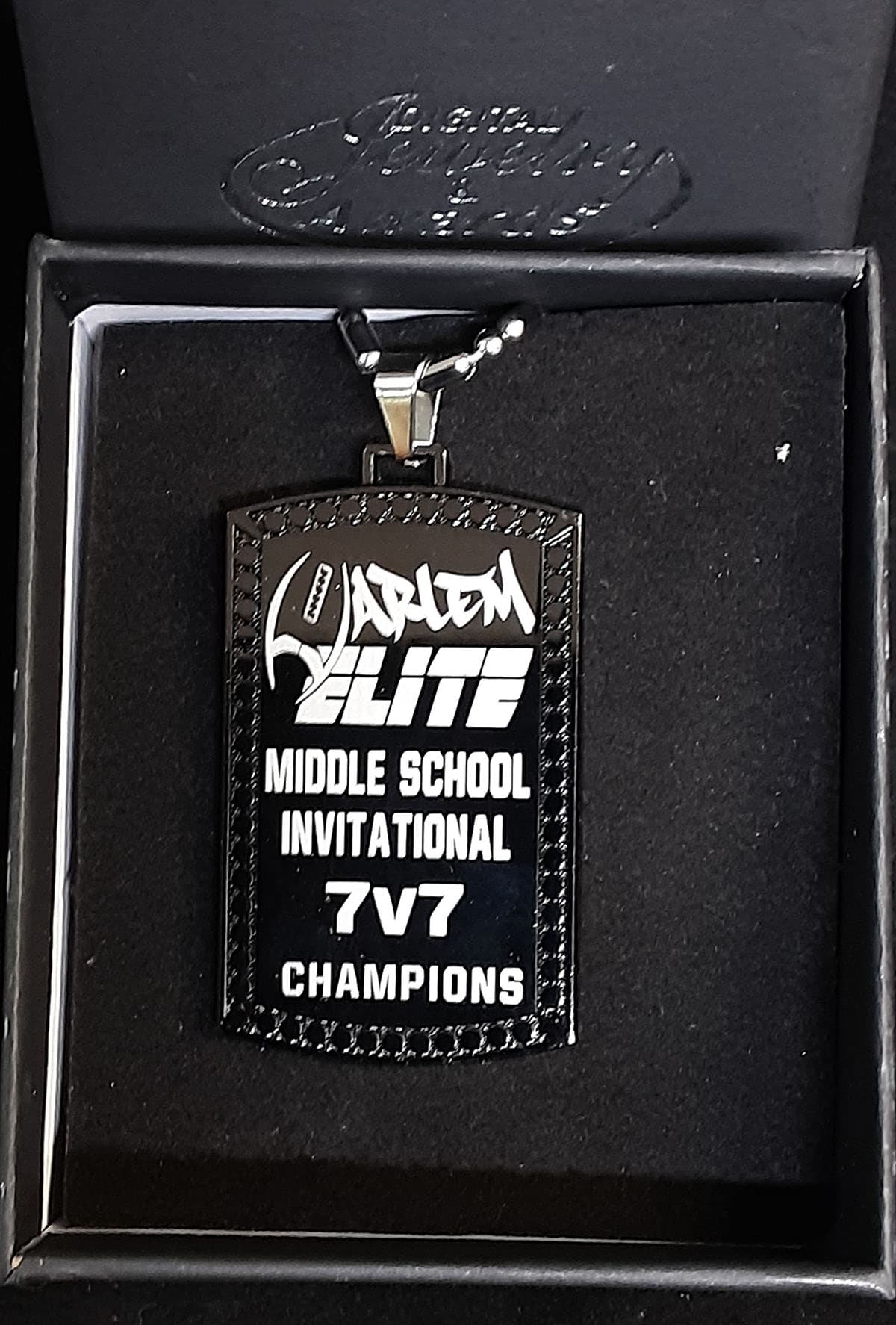
Commemorative tags take hard enamel fill in the recessed areas. Dark enamel against polished raised metal is what makes a detailed crest readable at tag scale.
Skip the fill on daily-wear operational tags. A plain matte finish holds up better and will not chip against gear.
What Separates a Real Manufacturer From a Reseller
Four questions settle it. Which alloy and grade, in writing? Who owns the press and the die set? What do I see before I pay? What is the delivery date, not the estimate?
A factory-direct shop answers all four on the first call. It names its grades, holds mil-spec blank dimensions, sets no minimum, sends a free 3D digital proof, and commits to 3 to 6 weeks. Colucci Custom Awards designs and manufactures in the United States, so the answer to who owns the press is us.
Need durable military dog tags, or a full recognition set built to match? Tell us the unit, the quantity, and the date on the calendar. Request a free quote and we will send a free 3D digital proof before you commit a dollar.
Frequently Asked Questions (FAQs)
What metal grade is best for military dog tags?
Grade 304 stainless steel covers most standard-issue and unit tags. Specify Grade 316L for saltwater, coastal, or chemical exposure, since the added molybdenum gives it stronger corrosion resistance.
What is the difference between embossed and debossed military tags?
Embossing pushes characters up from the back of the tag, creating raised lettering. Debossing presses characters down into the front face, which protects the lettering from abrasion against fabric and gear.
Is there a minimum order for custom dog tags?
No. We build single replacement tags and full battalion runs on the same line, at factory-direct pricing either way.