A championship ring is the loudest piece of hardware an athlete will ever wear. Coaches and athletic directors want that same weight and shine for their own programs, and the obstacle is almost always the same pair: a capped athletic budget and a banquet date that will not move.
The ring that set the standard for all of them was issued after the 1966 season: a 14-karat gold band holding one one-carat diamond, awarded to the Green Bay Packers, per the Pro Football Hall of Fame.
Buyers still look to the professional game to decide what a championship ring should look like. That history hands schools, youth leagues, and fantasy leagues a design baseline they can afford to copy, which is why so many football championship rings ordered today borrow straight from it.
The original baseline did not hold for long. Recent professional rings carry hundreds of diamonds across the crown, the bezel, and the side panels. Vince Lombardi worked directly with Jostens on the 1966 design, and Jostens has produced most professional football championship rings since.
Key Takeaways: The Evolution of Custom Championship Awards and Rings
- The foundation: the 1966 Green Bay Packers set the benchmark with a 14-karat gold band and a single one-carat diamond.
- The escalation: modern professional rings traded the lone stone for hundreds of diamonds that tell a statistical story about the season.
- The manufacturer: Jostens made the first ring and has produced most professional football championship rings since.
- The local application: high schools, youth leagues, and fantasy leagues order custom championship rings made in the USA today with no minimum order.
The 1966 Green Bay Packers Foundation
Super Bowl ring history starts with a restrained piece of jewelry by modern standards. After the 1966 season, the Green Bay Packers received the first professional football championship rings, and that design still shapes high school and college ring work six decades later.
The piece centered on a solid 14-karat gold band. That metal stood up to daily wear by working athletes and carried real weight on the hand.
Lombardi stayed involved through the creative process. He worked with Jostens on a ring built around one one-carat diamond set inside a globe motif, a shape chosen to stand for team achievement. The outer bezel carried the words “World Champions Green Bay Packers 1966” in clean type.
That restraint defined the early era. One diamond represented one team effort. No hidden messages, no crowded side panels, no excess. The accomplishment carried the design, and the Lombardi collaboration set the precedent for teams working hand in hand with their manufacturer.
The Escalation of Diamonds and Design
Ring design tracked the commercial growth of professional football. The one-carat standard faded fast. As revenue climbed, the jewelry grew in size, stone count, and complexity.
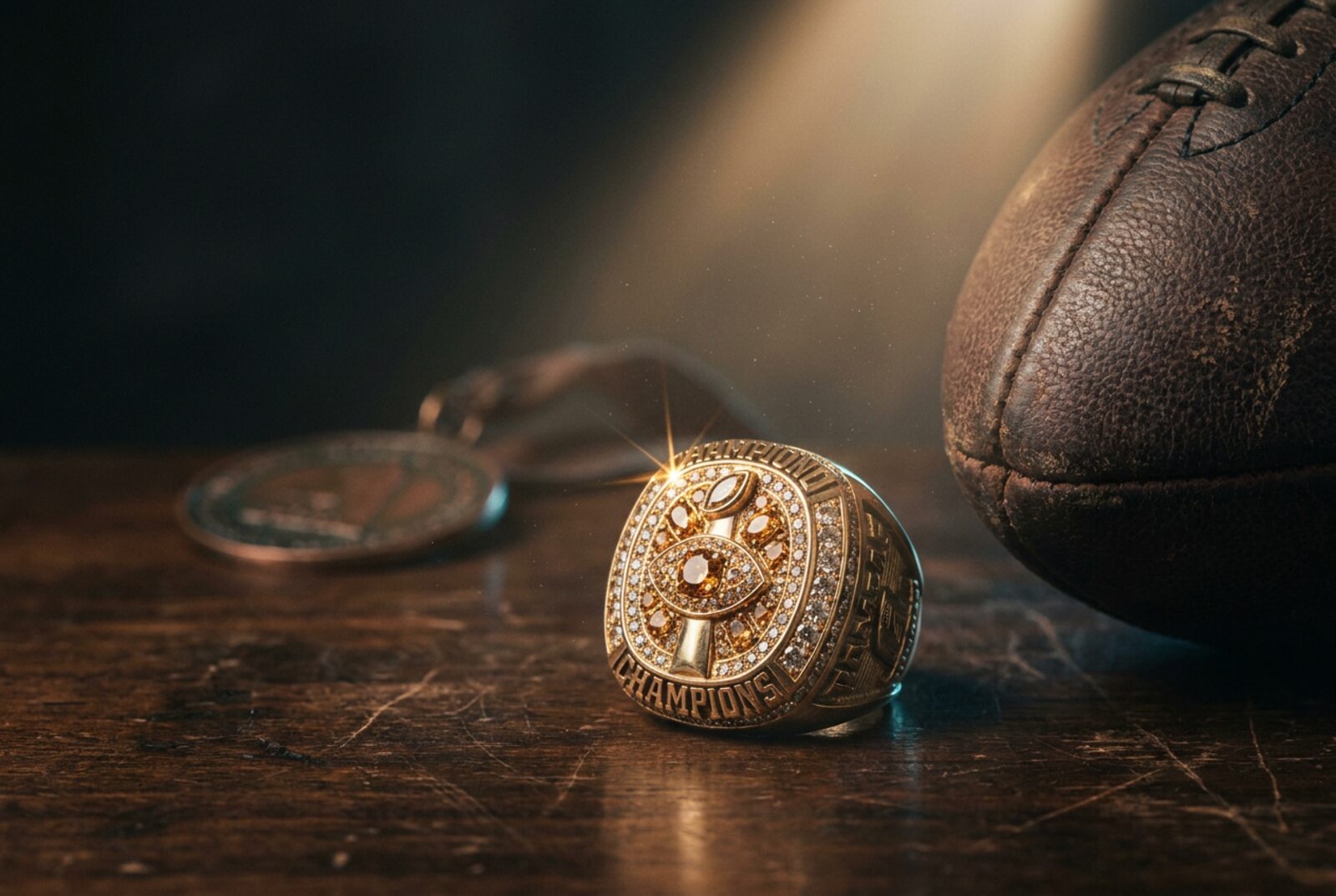
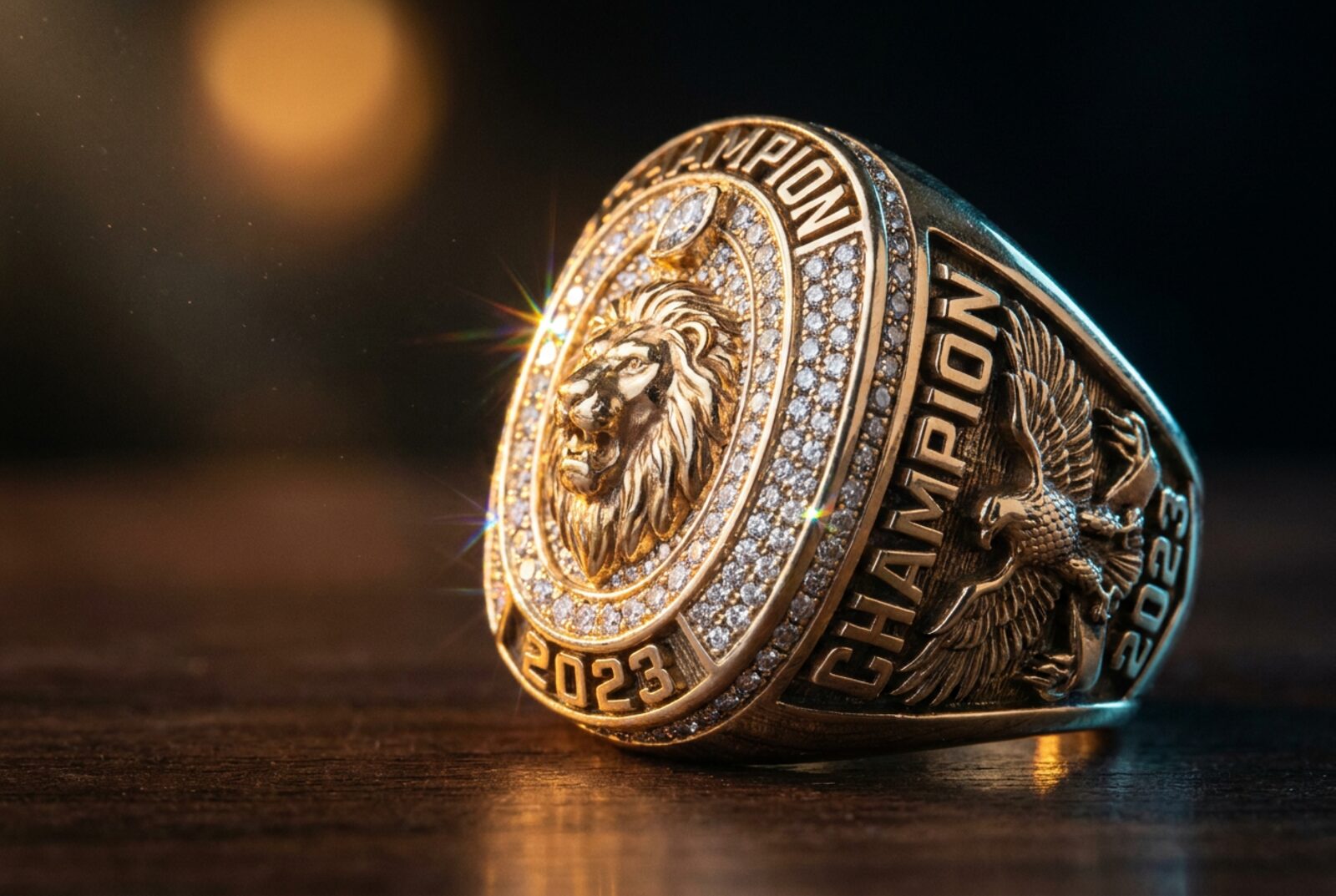
Recent rings carry hundreds of diamonds across the crown, bezel, and side panels. Franchises treat them as storytelling devices now, not simple commemorative bands.
Stone counts carry meaning. A set of rubies can match the points scored during a playoff run. A cluster of gems can mark consecutive division titles. Side panels record the season record, the final score, and the player number.
That stone volume demands real CAD engineering so the ring stays wearable on the hand. Weight, shank thickness, and comfort now drive as many design decisions as sparkle does.
Copying Professional Ring Standards on a School Budget
Coaches and athletic directors consistently ask us how to land the professional look without the professional invoice. Seven obstacles stand in the way, and every one of them is answerable before you place an order.
- Budget limits: professional organizations spend tens of thousands of dollars per player ring. High schools and youth leagues work from a capped athletic budget. You need a manufacturer who scales the design down without losing the craftsmanship.
- Minimum orders: plenty of manufacturers will not touch a small batch. A booster club needs 30 rings. A fantasy league needs one. Factory minimums lock both out.
- Delivery dates: the championship banquet and senior night sit on fixed dates. A late delivery kills the moment, and few vendors put a delivery window in writing.
- No rendered proof: teams commit thousands of dollars off a flat sketch. Without a rendered 3D design of the actual ring, the finished piece looks nothing like what the coach pictured.
- Tarnish and skin marks: low-grade overseas metal discolors after a few weeks of daily wear and leaves the green finger that every parent complains about. Ask for tarnish-resistant metal by name.
- Hidden setup fees: a per-ring price that excludes mold, die, or art-setup charges is not the real price. Ask for one all-in number per ring.
- Slow answers: a design question that takes three days to clear a time-zone gap puts the banquet date at risk. Ask who answers the phone during the build.
Ring Sourcing Options Compared
Here is how the common sourcing paths stack up for a local program. Treat the table as a question list: confirm minimums, metal, and the delivery date in writing with any vendor, including us.
| Sourcing option | Minimum order | Turnaround | Proof before payment | Where it is made |
|---|---|---|---|---|
| Colucci Custom Awards | None. Order 1 ring or 100. | 3 to 6 weeks | Free 3D proof, unlimited revisions | United States |
| National catalog vendor | Commonly set by a school contract. Ask for the number in writing. | Longer production windows. Confirm the date in writing. | Catalog photo or flat sketch | Varies disclosed |
| Overseas online seller | Low, though metal grade varies | Production plus customs clearance | Photo of a similar ring | Overseas |
| Local jewelry store | Usually one piece | Set by whichever shop it is subcontracted to | Hand sketch | Subcontracted out |
Choosing Materials for a USA-Crafted Team Ring
Translating a professional look into an affordable team championship ring comes down to materials. Metal and stones decide the weight, the durability, and the shine.
The base metal is the structure. The 1966 rings used solid 14-karat gold. Each one holds a white or yellow gold finish and stays tarnish-resistant through daily wear, which is what keeps an alloy ring from turning a finger green.
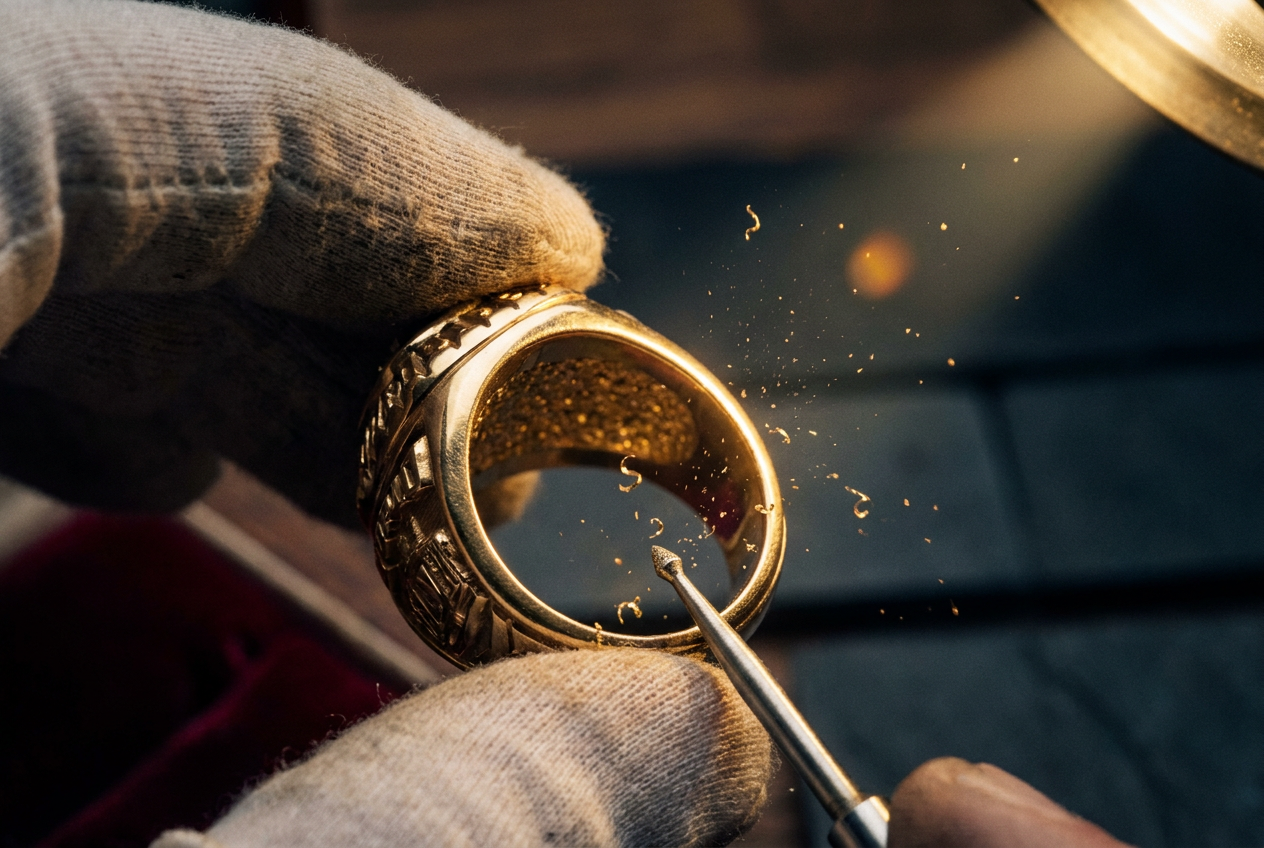
Stones do the visual work. Recent professional rings use hundreds of diamonds. Colored stones channel-set around a large center crest give you the stadium look, and every stone is hand-set so it stays put through a decade of wear.
The design gets settled before any metal is cut. Our free 3D proof renders the crown, both side panels, and the inner band engraving, so the coach approves the real thing instead of a sketch.
Three Answers That Decide Where Your Rings Get Made
Ask every vendor the same three questions before you commit a dollar. First, what is the minimum order quantity in writing, because a 14-player roster should never pay a penalty for its size. Second, what is the committed delivery date, as a date and not a range of months. Third, do you render a 3D proof before any deposit, showing side panels, stone placement, and engraving in three dimensions.
Colucci Custom Awards answers all three the same way every time: no minimum order, 3 to 6 weeks, and a free 3D proof with unlimited revisions until your team signs off. We design, render, and manufacture in the United States, and we own the manufacturing, so there is no middle-man markup. A fantasy league ordering one ring gets the same bench time as a program ordering one hundred. If what you want is a fan tribute piece rather than a team award, we build Super Bowl-style replica rings as clearly labeled fan tribute collectibles.
Ready to build your own championship hardware? Request a free quote and we will send a complimentary 3D proof of your design.
Want the look without the league marks? See Super Bowl style rings and replica championship rings, priced per ring from a single piece.
Frequently Asked Questions (FAQs)
Who received the very first professional football championship ring?
The Green Bay Packers received the first rings after the 1966 season. Head coach Vince Lombardi worked directly with Jostens on the design for the full roster.
What did the original 1966 championship ring look like?
It was a solid 14-karat gold band holding one one-carat diamond. The diamond sat inside a globe motif, circled by the words “World Champions Green Bay Packers 1966” on the bezel.
How much do custom team championship rings cost?
Pricing moves with four things: the metal you choose, the stone count, how much detail goes on the side panels, and how many rings you order. The exact number arrives with your free 3D proof, so you see the design and the price together before committing.
Are Colucci Custom Awards championship rings made in the USA?
Yes. We design, render, and manufacture every ring in the United States, and we own the manufacturing, so there is no middle-man markup and no customs delay between the proof and the banquet.
Can a high school team order a ring that looks like a professional design?
Yes. Domestic manufacturers scale professional aesthetics to a local budget.
How long does it take to manufacture a custom team ring?
Plan on 3 to 6 weeks from design sign-off. That window puts finished rings in players’ hands before senior night and the end-of-season banquet when the 3D proof is approved early.
Are Super Bowl-style replica rings legal to buy?
Yes. Replica and fan tribute rings are legal to purchase and own when they are positioned as fan tributes and do not carry protected league logos or team trademarks without authorization. Our replica rings carry your own personalization, your name, your design, your inscription, and we do not produce officially licensed league merchandise.